Showing posts with label insect. Show all posts

Dec 28, 2022

Insect Hotel Update

Resin Bee (Megachile ferox)
 
Update from the insect hotel, a Resin Bee (Megachile ferox), had layed her eggs deep in one of drilled holes and was in the process of sealing the entrance when I took this shot.

1/250 - f/7.1 - ISO200 - 50mm + 31mm extension tube.

Jun 29, 2022

False Garden Mantis, (Pseudomantis albofimbriata)

The egg sac of a False Garden Mantis, (Pseudomantis albofimbriata), adhered to the trunk of a young Plum tree.

1/250 - f/16 - ISO400 - macro
 

Feb 6, 2022

Slender Ringtail Damselfly (Austrolestes analis, Fam: Lestidae)

Slender Ringtail Damselfly (Austrolestes analis, Fam: Lestidae)

The Slender Ringtail Damselfly, scientifically known as Austrolestes analis, is a beautiful and fascinating insect belonging to the damselfly family Lestidae. It is characterized by its slender body structure with a length of approximately 3.5 to 4.5 centimeters, making it one of the smaller damselflies.

This species is renowned for its striking and vibrant coloration. Their bodies are predominantly metallic black, accompanied by delicate patterns of vibrant blue or purple on the thorax and abdomen. Adult males of the Slender Ringtail Damselfly generally display more intense colors and may possess bright turquoise or indigo hues, while females exhibit a paler and less vibrant color palette.

The damselfly's compound eyes are large and noticeable, providing excellent vision, aiding in hunting as well as identifying potential predators or mates. They have transparent, elongated wings, giving them the ability to glide effortlessly through the air with incredible agility and precision. Their delicate wings are adorned with intricate, iridescent patterns that sparkles when hit by sunlight.

Found across New South Wales, Queensland, and Victoria in Australia, the Slender Ringtail Damselfly prefers habitats near slow-flowing streams, marshes, and still waters such as ponds or wetlands. They can be seen gracefully perching on vegetation or branches, waiting patiently for their prey to venture within striking distance.

As carnivorous insects, the Slender Ringtail Damselfly feeds on small invertebrates, including tiny insects, smaller damselflies, mosquitoes, and flies. They employ their remarkable agility and superb flying abilities to capture prey mid-air with their strong, grasping forelegs. They are an essential part of the ecosystem, helping to control insect populations.

Breeding behavior in the Slender Ringtail Damselfly is intriguing. Males will establish territories near water bodies and engage in vibrant aerial displays to attract females. During mating, males clasp the females behind their heads using specialized appendages called claspers. Afterward, females lay their eggs underwater, attaching them to plant stems or leaves.

With their captivating appearance and graceful flight, the Slender Ringtail Damselfly has become a favorite subject for insect enthusiasts and photographers alike. However, their populations have experienced decline due to habitat loss and degradation, making them a species of conservation concern. Efforts aimed at protecting their habitats and raising awareness about their significance in the ecosystem are critical for their survival.

1/250 - f/11 - ISO200 - 135mm + 31mm, 21mm, 13mm extension tubes + diffused flash.


Jan 22, 2022

Common Blue Grass Butterfly (Zizina labradus)

Common Blue Grass Butterfly (Zizina labradus)

The Common Blue Grass Butterfly, also known as the Zizina labradus, is a small and delicate butterfly species that can be found in various parts of Europe, North Africa, Asia and Australia. It belongs to the family Lycaenidae and is one of the most widespread and abundant butterflies in its range.

This butterfly species is characterized by its beautiful blue coloration on the upper side of its wings, which gives it its common name. However, the shade of blue can vary from light to a deep and vibrant hue, depending on geographical location and gender. The males typically have a brighter blue color compared to the females, who tend to have a more subdued tone.

The wingspan of the Common Blue Grass Butterfly ranges from 25 to 38 millimeters, making it relatively small in size. Its wings are adorned with intricate patterns of black spots, which provide a striking contrast against the vibrant blue background. The underside of the wings is a pale grayish color with black spots, providing camouflage and protection from predators when the butterfly rests or feeds on flowers.

In terms of behavior, these butterflies are known to be active during sunny and warm weather, typically from spring to late summer. They are often seen flying low to the ground in grassy and meadow habitats, hence their name. The Common Blue Grass Butterfly feeds on nectar from a variety of flowers, particularly those with open shapes, such as thistles and clovers.

The lifecycle of this butterfly follows the typical stages of egg, larva (caterpillar), pupa, and adult. The female lays her eggs on the undersides of leaves, usually near the host plants that will provide food for the caterpillars. The caterpillars have a greenish color with white stripes and feed primarily on legumes, such as clovers and vetches. The pupa stage takes place in a sheltered area, and after a few weeks, the adult butterfly emerges, ready to continue its lifecycle.

Overall, the Common Blue Grass Butterfly is a beautiful and common sight in many grasslands and meadows. Its vibrant blue coloration and graceful flight make it a delightful addition to the natural landscape.

1/100 - f/6.3 - ISO400 - macro


Nov 8, 2021

Beefly, Erstalis tenax

A Beefly, (Erstalis tenax), feeding on nectar from a rose flower.

1/200 - f/5 - ISO64 - macro
 

Nov 5, 2021

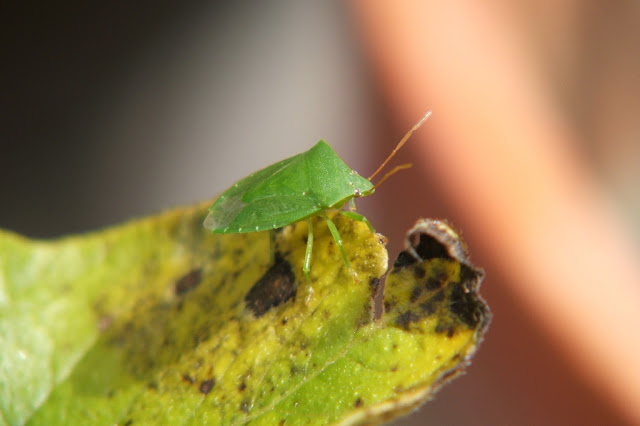
Green Shield Bug, Chinavia hilaris

Green Shield Bug (Palomena prasina)

The Green Shield Bug, also known as the Green Stink Bug (Palomena prasina), is a vibrant and distinctive insect belonging to the family Pentatomidae. As its name suggests, it exhibits a vibrant green coloration on its body, which serves as an effective camouflage among vegetation, especially leaves.

These bugs are typically small to medium-sized, measuring around 1.5 centimeters in length, with a shield-shaped, broad body. Their bodies are oval in shape and have a hardened, textured exoskeleton that acts as protection from predators.

One of the most notable features of the Green Shield Bug is its visually striking antennae, consisting of alternating dark and light segments. Additionally, it possesses a pair of large, dark eyes located on either side of its head, enabling it to have a good field of vision.

Green Shield Bugs are commonly found in temperate regions of Europe, Asia, and Africa, where they have adapted to a variety of habitats, including gardens, woodlands, meadows, and agricultural lands. They are known to be particularly attracted to plants such as nettle, ivy, and hawthorn.

These bugs are herbivorous and primarily feed on plant sap by piercing the tissues with their long, needle-like mouthparts. While they are not considered harmful to humans, they can occasionally cause damage to crops and garden plants. However, they also contribute positively to the ecosystem by preying on other insects, such as aphids, caterpillars, and beetle larvae.

Mating occurs during late spring or early summer, and the female Green Shield Bug lays eggs on leaves of host plants, usually in clusters. The eggs are small, barrel-shaped, and have a greenish color, blending well with the surrounding vegetation. Once hatched, the young nymphs resemble the adults but are smaller and lack wings.

Throughout their lifecycle, Green Shield Bugs undergo several molting stages, shedding their exoskeleton and growing larger with each phase. The length of their lifecycle can vary depending on environmental conditions, typically ranging from two to three months.

Overall, the Green Shield Bug is an intriguing insect known for its vibrant green coloration, distinct shield-shaped body, and beneficial role in ecological balance. Its ability to adapt to various habitats and diet preferences makes it an essential component of the natural world around us.

1/550 - f/3 - ISO64 - macro
 

Oct 4, 2021

Spotted Flower Chafer - Neorrhina punctatum

Spotted Flower Chafer (Neorrhina punctatum)

This is the first time I have encountered this species in our garden, the Spotted Flower Chafer, (Neorrhina punctatum). The beetle is pale brown in colour with many large black dots on its thorax and wing covers. Flower chafers feed on nectar and are often found among the petals of flowers, I found this one feeding on some field daisies.

1/150 - f/5.6 - ISO64 - macro


Sep 14, 2021

Painted Lady Butterfly, Vanessa kershawi

Painted Lady (Vanessa kershawi), resting on the lawn in the mid-morning sun.

The Australian Painted Lady butterfly, scientifically known as Vanessa kershawi, is a stunning and vibrant butterfly species native to Australia. Its striking appearance and distinctive wing patterns make it a beloved and recognizable species among entomologists and nature enthusiasts alike.

The wings of the Australian Painted Lady feature a beautiful combination of bright orange, black, and white markings. The forewings exhibit a pattern of black spots on an orange background, which extends into a white bar near the tips. The hindwings, on the other hand, boast intricate black and white patterns that create an eye-catching contrast against the vibrant orange color.

With a wingspan reaching approximately 5-7 centimeters, the Australian Painted Lady is a medium-sized butterfly. When in flight, it gracefully flutters from flower to flower, seeking nectar as its main source of nutrition. The butterfly has a preference for a variety of flowering plants, including native wildflowers, asters, and thistles.

A unique aspect of this butterfly species is its migratory behavior. Australian Painted Lady butterflies undertake impressive annual migrations across vast distances, often traveling from their breeding grounds in the inland areas to the coastal regions. These migrations are thought to be influenced by favorable climate conditions and the availability of food sources.

The Australian Painted Lady butterfly undergoes a complete metamorphosis, starting from an egg that hatches into a caterpillar. The caterpillar exhibits a black body covered in fine spines and feeds on host plants such as Gnaphalium and Helichrysum. After undergoing several molts, the caterpillar forms a pupa or chrysalis, within which the transformation into a fully grown butterfly takes place. The entire life cycle of this butterfly lasts for several weeks.

In addition to its exquisitely beautiful appearance, the Australian Painted Lady butterfly also plays an important ecological role as a pollinator. As it flits from flower to flower sipping nectar, it inadvertently transfers pollen, aiding in the reproduction of various plant species.

Overall, the Australian Painted Lady butterfly is an enchanting and dynamic species that showcases the remarkable wonders of nature. Its vibrant colors, migratory behavior, and ecological significance make it a true treasure of the Australian insect world.

1/2500 - f/5.6 - ISO400 - 135mm macro
 

Sep 3, 2021

Green katydid Nymph, Caedicia simplex

Caedicia simplex Katydids look like grasshoppers and are leaf feeders. This one was perched on the leaf of Dock weed for a few days until the heavy rain started.
 

1/200 - f/9 - ISO200 - diffused flash - macro

Apr 25, 2021

Longicorn Beetle (Cerambycidae f.)


Longicorn Beetle (Cerambycidae family) also known as Long-horned Beetle. In Australia we have four longicorn subfamilies, Cerambycinae and Lamiinae are common while Prioninae and Parandrinae are rare. Longicorn Beetles lay eggs  in the cracks of bark or under bark and most larvae are wood borers.

Buy this image

1/200 - f/8 - ISO200 - macro

Mar 24, 2021

Golden-tailed Spiny Ant (Polyrhachis spp.)


Golden-tailed Spiny Ant (Polyrhachis spp.)

The Golden-tailed Spiny Ant is a fascinating insect native to Southeast Asia. It is part of the ant family, Formicidae, and is known for its striking appearance and unique features.

This ant species gets its name from the golden-colored tip of its abdomen, which is highly visible and distinguishes it from other ant species. The ant's body is covered in dense spines, giving it a spiky and intimidating appearance.

Measuring around 7-12 millimeters in length, the Golden-tailed Spiny Ant is relatively small compared to other ant species. It has a slender and elongated body with a distinctive narrowing waist, known as the petiole. The ant's head is large and equipped with powerful mandibles for both feeding and defense.

Colony life is a key aspect of the Golden-tailed Spiny Ant's behavior. These ants are social insects and live in organized communities led by a queen. They construct intricate subterranean nests consisting of interconnected chambers, tunnels, and galleries. This species prefers nesting in soil or rotten wood, providing them with protection and an ideal environment for raising their young.

The Golden-tailed Spiny Ant is an omnivorous species, feeding on a variety of food sources. Their diet includes small insects, nectar, plant sap, and even honeydew produced by aphids. They are known to be highly efficient predators and have been observed working together as a team to capture larger prey.

Despite its intimidating appearance, the Golden-tailed Spiny Ant is generally not aggressive towards humans unless provoked. However, when threatened, it can deliver a painful sting using its venom-filled stinger. The venom is not dangerous to humans, but it can cause discomfort and a localized reaction.

In nature, these ants play a vital role in maintaining ecological balance. They contribute to the decomposition of organic matter, controlling populations of small insects, and aiding in the dispersal of plant seeds.

The Golden-tailed Spiny Ant is a captivating creature with its spiky exterior and unique behavior. Its distinctive appearance, social structure, and ecological importance make it a fascinating subject of study for entomologists and nature enthusiasts alike.

1/200 - f/9 - ISO100 - macro - diffused flash

Mar 21, 2021

False garden Mantis underside


One thing about photographing a False garden Mantis (Pseudomantis albofimbriata), is they always seem to be upside down. So here's a shot, taken from above, showing the underside of the Mantis. This specimen is a male.

1/200 - f/9 - ISO100 - diffused flash

Mar 12, 2021

Rufous Grasshopper


The Rufous grasshopper or Gomphocerippus rufus (synonym Gomphocerus rufus and others), is a medium-sized, broad, brown, 'short-horned' grasshopper with clubbed antennae that are tipped with a conspicuous white or pale colour. It is fairly large, averaging 14 to 22 mm in length. It is of the subfamily Gomphocerinae in the family Acrididae, the predominant family of grasshoppers. This species is present in most of Europe, in the eastern Palearctic ecozone and in the Near East. It can be encountered from late July through mid-December, usually in dry or slightly moist habitats. The environments in which it typically resides include dry grassland on calcareous soils, sheltered valleys with scrub, and the open borders of forests. It feeds on grasses and various herbaceous plants. It is known for its distinctive courtship song and accompanying display.


1/200 - f/9 - ISO100 - 55mm + 31mm macro extension - diffused flash

Mar 2, 2021

Honey Bee (Apis mellifera)


A Honey Bee, (Apis mellifera), snapped just as it was landing on a Clover flower.

1/200 - f/8 - ISO100 - macro

Feb 26, 2021

Passionvine hopper (Scolypopa australis)


Passionvine hopper, (Scolypopa australis), is native to Australia and has been introduced to New Zealand. Despite its name, they are found not only on passion vines, but on many plant species, including kiwifruit and the lantana. They are brown with partly transparent wings, about 5–6 mm long as adults and 4-5 mm as nymphs.

Buy this image

1/200 - f/8 - ISO100 - macro - diffused flash

Feb 25, 2021

Barred Skipper (Dispar compacta) Butterfly


The Barred Skipper, (Dispar compacta), butterfly is a small type of "skipper". The adult butterfly is brown, with a few white and yellow markings on the wings. It has a wingspan of about 45 - 50 mm. The Barred Skipper is found mainly along the eastern side of mainland Australia.

1/100 - f/7.1 - ISO400 - macro

Feb 24, 2021

Fruit Fly (f. Tephritidae)


A major agricultural problem for fruit growers in Australia is Fruit fly, (f. Tephritidae). These flies inhabit fruits and vegetables to which they cause severe destruction and degradation. There are strict border controls in place for the transport of fruit across state borders in Australia.

Buy this image

1/200 - f/8 - ISO100 - macro - diffused flash

Feb 23, 2021

Ladybird Beetle (Coccinella transversalis)


The common spotted ladybird, (Coccinella transversalis), is bright orange with black dots on its back. They're voracious predators of aphids, scale insects and mites. Ladybirds are very common in gardens all around Australia.

Buy this image

1/200 - f/8 - ISO100 - macro - diffused flash

Feb 21, 2021

Thread-legged bug (Stenolemus bituberus)


One of the strangest, yet most interesting insects I've ever encountered. A Thread-legged bug, (Stenolemus bituberus), spends almost it's entire life in spider webs and feeds mainly on spiders, moving from one web to the next, devouring the web creator.


1/200 - f/8 - ISO100 - macro

Feb 11, 2021

Common European Wasp


A European Wasp, (Vespula vulgaris), perched on a piece of Eucalyptus bark. Also known as the common wasp, is found all over Australia and has a nasty sting.


1/200 - f/11 - ISO200 - diffused flash - 55mm

All images displayed on this website © 2021 Andrew K Waugh. All Rights Reserved.