 |
| Common Blue Grass Butterfly (Zizina labradus) The Common Blue Grass Butterfly, also known as the Zizina labradus, is a small and delicate butterfly species that can be found in various parts of Europe, North Africa, Asia and Australia. It belongs to the family Lycaenidae and is one of the most widespread and abundant butterflies in its range. This butterfly species is characterized by its beautiful blue coloration on the upper side of its wings, which gives it its common name. However, the shade of blue can vary from light to a deep and vibrant hue, depending on geographical location and gender. The males typically have a brighter blue color compared to the females, who tend to have a more subdued tone. The wingspan of the Common Blue Grass Butterfly ranges from 25 to 38 millimeters, making it relatively small in size. Its wings are adorned with intricate patterns of black spots, which provide a striking contrast against the vibrant blue background. The underside of the wings is a pale grayish color with black spots, providing camouflage and protection from predators when the butterfly rests or feeds on flowers. In terms of behavior, these butterflies are known to be active during sunny and warm weather, typically from spring to late summer. They are often seen flying low to the ground in grassy and meadow habitats, hence their name. The Common Blue Grass Butterfly feeds on nectar from a variety of flowers, particularly those with open shapes, such as thistles and clovers. The lifecycle of this butterfly follows the typical stages of egg, larva (caterpillar), pupa, and adult. The female lays her eggs on the undersides of leaves, usually near the host plants that will provide food for the caterpillars. The caterpillars have a greenish color with white stripes and feed primarily on legumes, such as clovers and vetches. The pupa stage takes place in a sheltered area, and after a few weeks, the adult butterfly emerges, ready to continue its lifecycle. Overall, the Common Blue Grass Butterfly is a beautiful and common sight in many grasslands and meadows. Its vibrant blue coloration and graceful flight make it a delightful addition to the natural landscape. 1/100 - f/6.3 - ISO400 - macro |
Jan 22, 2022
Common Blue Grass Butterfly (Zizina labradus)
Nov 8, 2021
Beefly, Erstalis tenax

A Beefly, (Erstalis tenax), feeding on nectar from a rose flower.
1/200 - f/5 - ISO64 - macro
Nov 5, 2021
Green Shield Bug, Chinavia hilaris
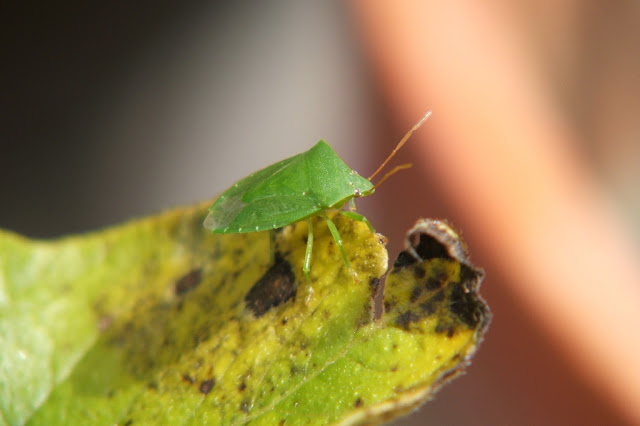
Green Shield Bug (Palomena prasina)
The Green Shield Bug, also known as the Green Stink Bug (Palomena prasina), is a vibrant and distinctive insect belonging to the family Pentatomidae. As its name suggests, it exhibits a vibrant green coloration on its body, which serves as an effective camouflage among vegetation, especially leaves.
These bugs are typically small to medium-sized, measuring around 1.5 centimeters in length, with a shield-shaped, broad body. Their bodies are oval in shape and have a hardened, textured exoskeleton that acts as protection from predators.
One of the most notable features of the Green Shield Bug is its visually striking antennae, consisting of alternating dark and light segments. Additionally, it possesses a pair of large, dark eyes located on either side of its head, enabling it to have a good field of vision.
Green Shield Bugs are commonly found in temperate regions of Europe, Asia, and Africa, where they have adapted to a variety of habitats, including gardens, woodlands, meadows, and agricultural lands. They are known to be particularly attracted to plants such as nettle, ivy, and hawthorn.
These bugs are herbivorous and primarily feed on plant sap by piercing the tissues with their long, needle-like mouthparts. While they are not considered harmful to humans, they can occasionally cause damage to crops and garden plants. However, they also contribute positively to the ecosystem by preying on other insects, such as aphids, caterpillars, and beetle larvae.
Mating occurs during late spring or early summer, and the female Green Shield Bug lays eggs on leaves of host plants, usually in clusters. The eggs are small, barrel-shaped, and have a greenish color, blending well with the surrounding vegetation. Once hatched, the young nymphs resemble the adults but are smaller and lack wings.
Throughout their lifecycle, Green Shield Bugs undergo several molting stages, shedding their exoskeleton and growing larger with each phase. The length of their lifecycle can vary depending on environmental conditions, typically ranging from two to three months.
Overall, the Green Shield Bug is an intriguing insect known for its vibrant green coloration, distinct shield-shaped body, and beneficial role in ecological balance. Its ability to adapt to various habitats and diet preferences makes it an essential component of the natural world around us.
1/550 - f/3 - ISO64 - macro
Subscribe to:
Posts (Atom)
-
Slender Ringtail Damselfly (Austrolestes analis, Fam: Lestidae) The Slender Ringtail Damselfly , scientifically known as Austrolestes anali...
-
 Golden-tailed Spiny Ant (Polyrhachis spp.) The Golden-tailed Spiny Ant is a fascinating insect native to Southeast Asia. It is part of ...
 -
 Although Garlic chives, (Allium tuberosum) , are classed as an invasive weed in Australia, they are grown by many people for use in cookin...
